For schools

SKIDS School Clinics care for children where they are.

SKIDS works where children grow: home, school, community, and clinic. A SKIDS partner school runs a SKIDS School Clinic: whole-child screening, school observation, parent-readable reports, pediatrician-visible records, and a care pathway for children who would otherwise be seen only when something goes wrong.

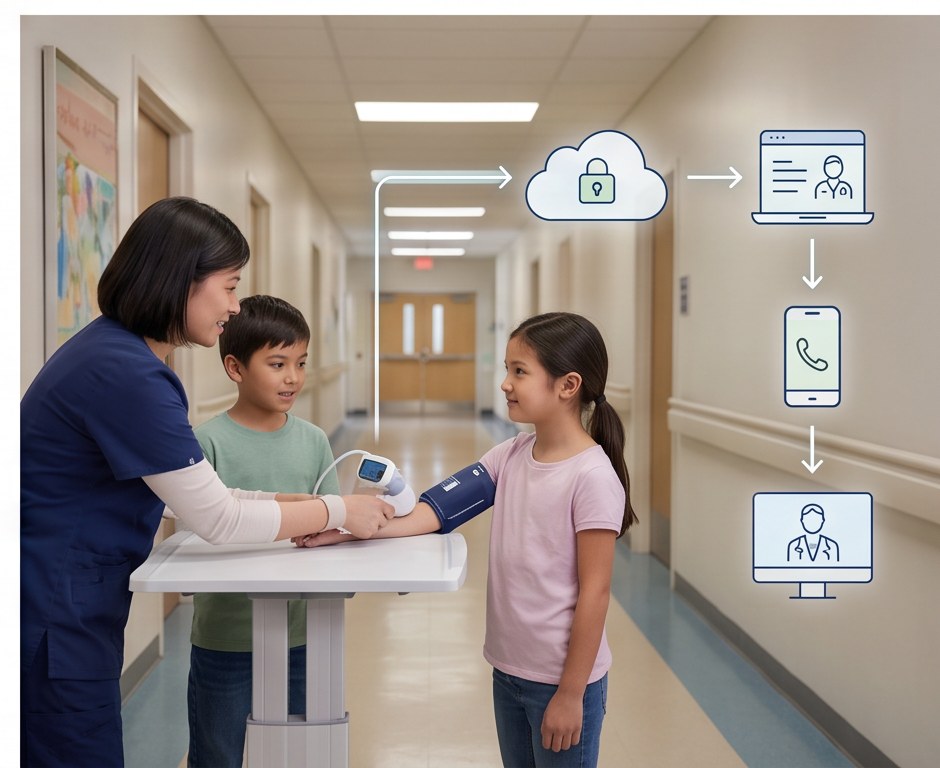
A SKIDS school clinic screening children during the school day
The school advantage

The school is a co-nurturer, not a compliance venue.

A child who cannot see the board, hear instructions, breathe well at night, sit with comfort, or regulate attention is not simply underperforming. The body is asking for help inside the classroom.

SKIDS makes the school an extension of pediatric primary care. The principal, teachers, parents, and pediatrician are no longer holding separate fragments. The school aligns with the direction set by CBSE, WHO, UNESCO, and modern preventive-health policy, but more importantly becomes part of building the whole child.

Diagram showing parent, school, and doctor connected by a digital child health record
The execution gap

The old model was built for compliance, not continuity.

RBSK, the School Health and Wellness Programme, WHO/UNESCO school-health guidance, and modern preventive-health priorities all point in the same direction. The weak point is execution: manual, partial, paper-based checks cannot give parents, schools, or pediatricians a full picture of the child.

Manual school screening systems shown as subjective, paper-based, and incomplete

Old screening was compliance-first

Manual checks, partial screens, paper records, subjective observations, and referral slips satisfy a file but rarely build a longitudinal child record.

Modern school health expects proof

Objective parameters, fast execution, auditable reports, parent-readable language, pediatric review, and a closed follow-up loop.

SKIDS turns screening into continuity

SKIDS becomes the school clinic operating layer: observation, devices, pediatric protocols, reports, follow-up care, and aggregate insight.

How it works

What happens inside a SKIDS School Clinic.

The school contributes access, context, and trust. SKIDS brings the clinical operating system: trained teams, devices, assisted signal capture, pediatric validation, parent reports, and follow-up pathways.

01

School clinic setup

The school shares rosters, rooms, communication windows, and the observations teachers already hold.

02

One-session screening

Children move through calm stations for vision, hearing, growth, nutrition, oral, respiratory, and development signals.

03

Signal organisation

Objective signals are organised into normal, monitor, and refer pathways so the pediatric team sees what needs attention.

04

Pediatric validation

Findings are reviewed by the SKIDS pediatric team before they become parent-facing recommendations.

05

Digital health passport

Each family receives a clear report with what was found, what it may mean, and what to do next.

06

Follow-up and dashboard

At-risk children enter a care pathway, while the school sees de-identified patterns for planning and support.

What SKIDS sees

One school day. Many body signals.

SKIDS does not screen one organ and call it health. The school programme combines daily observation with whole-child screening: physical, developmental, behavioural, and learning-linked signals.

Vision

Board-copying trouble, squinting, headaches, and silent myopia risk.

Hearing

Missed instructions, classroom attention, and speech-linked listening clues.

Growth

Height, weight, BMI, nutrition risk, and the pattern behind the number.

Mouth

Dental signals, mouth breathing, sleep clues, and airway-linked habits.

Regulation

Sleep, attention, anxiety, behaviour, and classroom participation signals.

Readiness

Development, speech, learning, and school-readiness checkpoints.

SKIDS school data

A growing school-health dataset. The signal is consistent.

The goal is not to alarm parents. It is to make the invisible visible early enough for simple, sensible care, and to give the child's pediatrician a picture that routine clinic visits rarely capture.

100,000+

Children observed and screened by SKIDS school teams, with the dataset growing every year

18-22%

Children with a finding worth a closer look

70+

Parameters translated into parent-readable body signals

48-72 hrs

Parent-ready reports after the screening day

SKIDS school screening showing one session, five minutes, and more than seventy parameters
SKIDS clinical workflow where AI tags risk and pediatricians validate reports
Digital health passport showing instant reporting, portability, and tele-health access for families
Implementation modes

One school-health system, three ways to deploy it.

SKIDS is not limited to a camp day. The same pediatric care system can operate as a School Clinic, augment a public child-health programme, or power child-health intelligence for large systems, while keeping the same goal: better whole-child outcomes.

Mode 01 Schools

SKIDS School Clinic for partner schools.

A school-led pediatric wellness clinic that brings whole-child screening, school observation, parent reports, pediatric review, compliance readiness, and follow-up into the life of the school.

Mode 02 Programmes

AI augmentation for community child-health programmes.

SKIDS can augment RBSK-style and other community-oriented child-health programmes without replacing frontline teams: objective capture, faster screening, parent-ready reports, referral routing, and dashboards.

Mode 03 Systems

Child-health index and public dashboards.

For large school-health missions, SKIDS can provide the intelligence layer: non-invasive screening, auditable digital trails, aggregate child-health indices, and dashboards for system leaders.

Why schools

The world is moving school health upstream.

The exact model differs by country, but the direction is consistent: health is not a side programme. When care moves closer to the child, barriers fall earlier and schools gain a clearer view of learning readiness.

Educational imperative curve showing higher impact of preventive intervention across childhood
1958

Japan makes school health a statutory system

School health moved from episodic inspection into law, with schools responsible for regular medical examinations and follow-up action.

1974

Japan adds urinary screening

A quiet test in school became a way to find asymptomatic kidney disease before it becomes life-altering.

1995

WHO launches the Global School Health Initiative

Health Promoting Schools made the global argument that health and learning should be planned together, not in separate silos.

2013

India launches RBSK

The national child-health programme takes screening to children from birth to 18 years, including schools, through the 4D framework.

2020+

India expands School Health and Wellness

Ayushman Bharat's school programme, implemented with CBSE, NCERT, and UNESCO support, makes health and wellness part of school life.

WHO + UNESCO 2.3B

School-age children in reach

Global standards for Health Promoting Schools treat school as a daily setting for living, learning, prevention, and early support.

WHO and UNESCO, Making Every School a Health-Promoting School
Japan 1974

Asymptomatic disease found at school

Japan's school urinary screening program shows how schools can detect silent kidney disease early, before illness becomes visible.

Kidney Research and Clinical Practice, 2024
India 160.84 cr

RBSK screenings at national scale

RBSK screens children for the 4Ds: defects at birth, diseases, deficiencies, and developmental delays including disability.

Press Information Bureau, Ministry of Health and Family Welfare, 2025
CBSE + UNESCO 30,000

Schools in the wellness programme

India's School Health and Wellness Programme makes health a school responsibility, not an occasional camp.

UNESCO, CBSE and NCERT School Health and Wellness Programme
Canada 824%

ROI for whole-school health

Economic modelling found whole-school health models had the strongest return among school-based health promotion approaches.

European Journal of Public Health, 2021
SKIDS Bangalore Growing

School screening, translated into care

SKIDS turns a school screening day into parent-readable reports, pediatric triage, follow-up, and one life record.

SKIDS school screening operations
The partnership model

The school co-nurtures. SKIDS provides the clinic system.

The school provides access, rooms, one point of contact, parent communication support, and the observations only a school can hold. SKIDS provides staff, devices, materials, reports, follow-up, and aggregate outcomes.

What the school gets

A pediatric wellness clinic inside the life of the school.

Every child gets a report. Every parent gets a next step. Every school gets de-identified patterns that help leadership see what children need, without asking teachers to become doctors.

Begin the conversation

If this fits your school, write to us.

Send the school name, city, approximate student strength, your role, and one thing you would like to ask SKIDS. Response within 5 working days.

hello@skids.clinic